Efficient irrigation management is one of the most effective ways to maintain a healthy landscape while reducing water waste, lowering utility costs, and protecting long-term property value. Whether you manage a rA healthy lawn depends on more than regular mowing, watering, and fertilization. Conditions beneath the grass and directly above the soil can determine whether turf roots receive the air, moisture, and nutrients they need to grow. Two lawn treatments commonly used to correct these problems are core aeration and dethatching, but they address very different conditions.
Understanding core aeration vs dethatching starts with identifying where the problem is occurring. Core aeration primarily addresses compacted soil beneath the lawn, while dethatching removes an excessive layer of organic material between the grass blades and soil surface. Choosing the appropriate treatment can improve turf health without subjecting the lawn to unnecessary stress.
What Is Core Aeration?
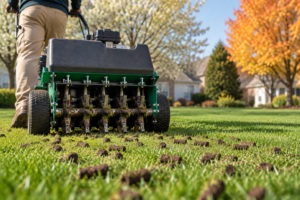
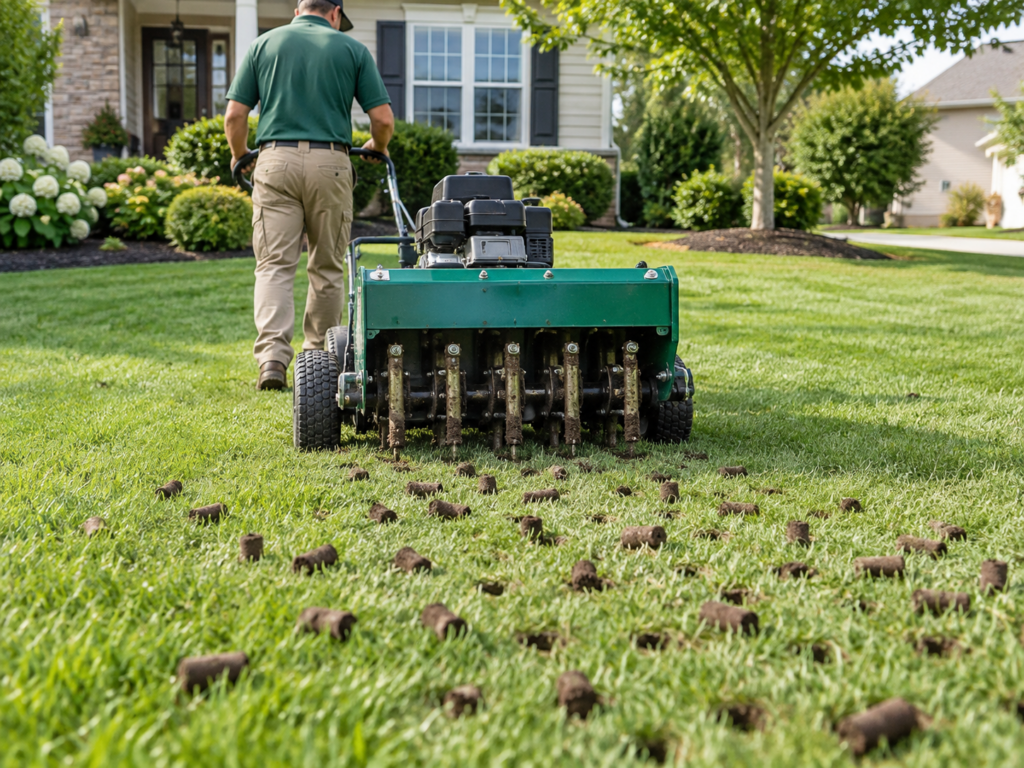
Core aeration is a lawn treatment designed to relieve soil compaction. A core aerator passes across the lawn and mechanically removes small plugs, or cores, of soil and turf from the ground.
Removing these plugs creates openings throughout the soil that allow important resources to penetrate more effectively. Instead of water, oxygen, and nutrients struggling to move through tightly packed soil, they have more direct pathways toward the grass roots.
Core aeration can help:
- Reduce soil compaction
- Improve air movement through the soil
- Increase water penetration
- Improve nutrient availability to grass roots
- Encourage deeper, stronger root development
- Reduce surface runoff and water pooling
- Create favorable conditions for overseeding
The soil plugs typically remain on the surface after treatment, where they gradually break down and return organic matter and nutrients to the lawn.
Precision Lawn & Landscape uses core aeration equipment that removes plugs of soil so grass roots have better access to water, nutrients, and air.
What Is Dethatching?
Dethatching targets a completely different part of the lawn. Thatch is the layer of partially decomposed grass stems, roots, and other organic material that develops between actively growing grass and the soil underneath it.
A small amount of thatch is normal and can actually benefit turf by helping insulate the soil and retain moisture. Problems develop when the layer becomes excessively thick.
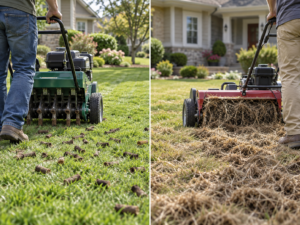
Dethatching uses specialized equipment or aggressive raking to pull accumulated thatch out of the lawn. Removing excessive buildup can reopen access to the soil surface and improve conditions for healthy turf growth.
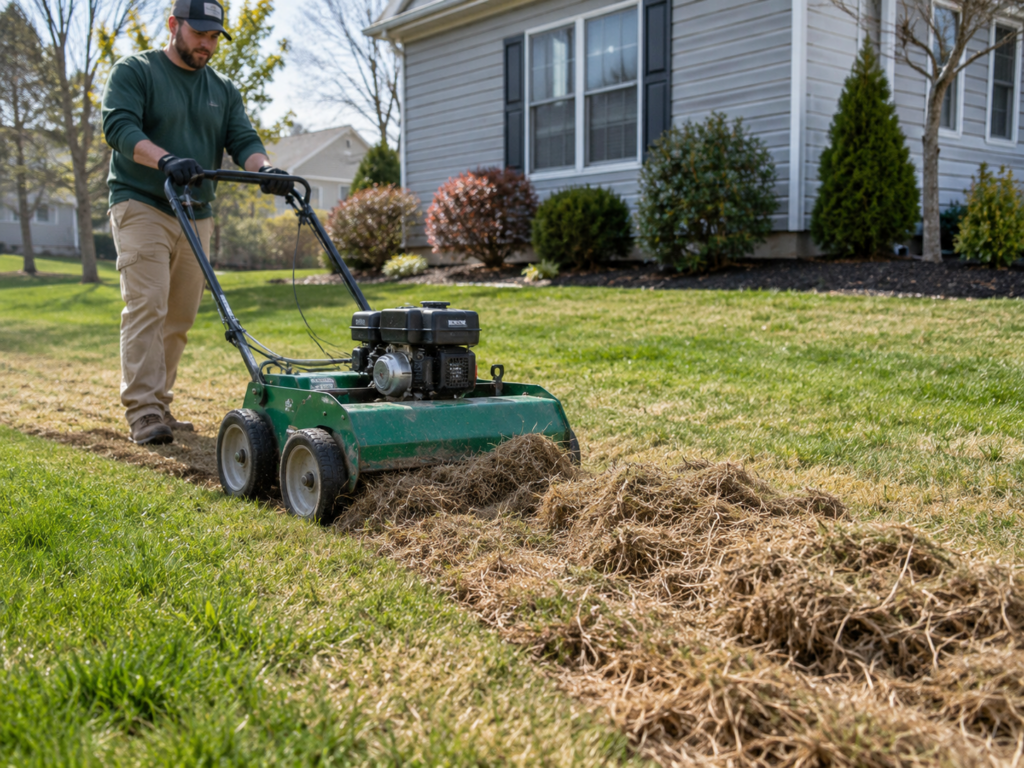
Dethatching may be beneficial when:
- The thatch layer exceeds roughly one-half inch
- The lawn feels unusually soft or spongy underfoot
- Water has difficulty reaching the soil
- Grass roots are growing primarily within the thatch layer
- Fertilizer and lawn treatments have difficulty reaching the root zone
- Turf appears stressed despite otherwise appropriate maintenance
Unlike routine mowing or light raking, dethatching can be relatively disruptive to established turf and generally should only be performed when significant thatch accumulation is actually present.
Core Aeration vs Dethatching: The Key Difference
The simplest way to understand core aeration vs dethatching is to look at the location of the problem.
Core aeration treats the soil. Dethatching treats the layer above the soil.
When soil becomes hard and compacted, aeration physically removes soil plugs to create space within the root zone. When excessive organic debris accumulates above the soil, dethatching removes that material so water, nutrients, and air can more easily reach the ground.
| Lawn Treatment | Core Aeration | Dethatching |
| Primary problem addressed | Compacted soil | Excessive thatch |
| Where the problem occurs | Within the soil | Between grass and soil |
| What the treatment removes | Small plugs of soil and turf | Dead stems, roots, and organic debris |
| Main goal | Improve soil structure and root access | Remove excessive surface buildup |
| Common signs it may be needed | Hard soil, runoff, pooling water, heavy traffic | Spongy turf, thick thatch, poor soil access |
| Typical frequency | Often annually or every other year when needed | Only when excessive thatch develops |
| Lawn disruption | Moderate and temporary | Can be more aggressive |
Both treatments can improve lawn health, but using them interchangeably can mean treating the wrong problem.
How Soil Compaction Affects Your Lawn
Soil contains tiny pore spaces that hold oxygen and allow water to move toward plant roots. Over time, pressure compresses those spaces and pushes soil particles more tightly together.
Compaction commonly develops from:
- Frequent foot traffic
- Children or pets regularly using the lawn
- Heavy lawn equipment
- Vehicles traveling across turf
- Construction activity
- Naturally dense or clay-heavy soil
- Repeated activity when soil is wet
Once the soil becomes heavily compacted, grass roots may struggle to expand. Rain and irrigation water may also remain near the surface rather than penetrating deeply into the ground.
The result can be shallow rooting, thinning grass, bare areas, poor nutrient uptake, and greater vulnerability to heat or drought stress.
Core aeration directly addresses this problem by physically opening compacted soil.
How Excessive Thatch Affects Your Lawn
Thatch is not simply a collection of grass clippings. Healthy soil microorganisms can usually break down normal lawn clippings relatively quickly.
Thatch develops when tougher plant materials such as stems, crowns, and roots accumulate faster than they decompose.
A modest layer can protect the lawn, but excessive thatch can begin acting like a barrier. Water and lawn treatments may have difficulty reaching the soil, while grass roots can begin growing within the thatch instead of deeper into the ground.
Heavy thatch can also create conditions that make the lawn more vulnerable to:
- Moisture stress
- Temperature fluctuations
- Certain insects
- Turf diseases
- Shallow root development
If the actual problem is excessive thatch rather than compacted soil, dethatching may provide the more appropriate corrective treatment.
Signs Your Lawn May Need Core Aeration
Several symptoms can suggest soil compaction is limiting lawn performance.
The Soil Feels Hard
Try pushing a screwdriver several inches into moist soil. Significant resistance may indicate that the soil has become densely compacted.
Water Pools After Rain or Irrigation
Compacted ground absorbs water slowly. If water frequently pools on the lawn or runs toward sidewalks and driveways, poor soil infiltration may be contributing to the problem.
The Lawn Receives Heavy Traffic
Lawns regularly used for recreation, pets, gatherings, or frequent walking are naturally more susceptible to compaction.
Grass Is Thin or Struggling
When roots cannot expand easily through the soil, turf may gradually become weak, thin, or patchy even when it receives adequate fertilizer and water.
Roots Are Shallow
Healthy turf generally benefits from deeper root development. Dense soil can prevent roots from extending farther into the ground where more moisture and nutrients may be available.
These conditions make core aeration particularly valuable because the treatment focuses directly on improving the soil environment.
Signs Your Lawn May Need Dethatching
When deciding between dethatching vs core aeration, inspect the area immediately above the soil.
Separate the grass blades and locate the brown layer between the green vegetation and ground. If this layer is unusually thick, dethatching may be warranted.
Other potential signs include:
- A soft or springy feeling when walking across the lawn
- Water sitting within the turf instead of reaching the soil
- Grass that can be pulled up easily
- A thick brown mat beneath the living grass
- Fertilizer or water appearing ineffective despite proper application
Measuring the thatch layer is more reliable than assuming any brown organic material is problematic. A thin layer is normal and does not automatically mean the lawn needs dethatching.
Dethatching vs Core Aeration: Which Is Better for Compacted Soil?
Core aeration is the better option for soil compaction.
Dethatching equipment works primarily near the soil surface and does little to relieve dense soil several inches below the grass. Removing thatch from a compacted lawn without addressing the soil itself may leave the underlying problem unchanged.
Core aeration removes plugs from the root zone, reducing soil density and creating channels for oxygen, moisture, and nutrients.
Lawns exposed to regular activity are especially likely to benefit from aeration because repeated pressure gradually compresses the soil.
Which Is Better for a Thick Thatch Layer?
Dethatching is typically the more direct solution when a lawn has developed an excessive layer of thatch.
Core aeration can indirectly support healthier decomposition by increasing soil-air interaction and bringing soil microorganisms closer to organic material at the surface. However, aeration is not designed to mechanically remove a severely accumulated thatch layer.
When thatch is substantially thicker than approximately one-half inch and is interfering with lawn performance, removing some of that material may be necessary.
Can a Lawn Need Both Aeration and Dethatching?
Yes. Soil compaction and heavy thatch can occur at the same time.
For example, a heavily used lawn may develop compacted soil from frequent traffic while also accumulating a substantial organic layer above the ground. In situations like these, both problems may eventually need to be addressed.
That does not mean every lawn should automatically receive both treatments. Aeration and dethatching both place temporary stress on turf, so treatments should be selected according to actual lawn conditions rather than performed simply because they are available.
A lawn professional can evaluate soil density, thatch thickness, turf condition, and other factors before determining the appropriate approach.
Does Core Aeration Help With Thatch?
Core aeration is not the same as dethatching, but it can sometimes help manage moderate thatch accumulation over time.
When soil cores are brought to the surface, soil microorganisms can mix with the organic material in the thatch layer. Those microorganisms contribute to the natural decomposition process.
Aeration also improves the overall soil environment, helping support healthier biological activity.
This means routine core aeration can contribute to good thatch management in some lawns. It does not, however, replace dethatching when the existing layer has already become excessively thick.
How Often Should You Core Aerate a Lawn?
The appropriate aeration schedule depends largely on soil conditions and how the lawn is used.
Heavily compacted lawns or properties with substantial foot traffic may benefit from annual core aeration. Lawns with relatively loose soil and minimal traffic may only need treatment every other year or when signs of compaction become noticeable.
Annual aeration is common because soil can gradually become compacted again through normal activity, rainfall, mowing, and seasonal conditions.
Rather than relying entirely on a predetermined schedule, homeowners should consider how the soil and grass are actually performing.
How Often Should You Dethatch a Lawn?
Dethatching should not automatically become an annual lawn maintenance task.
Because the treatment aggressively removes material from within the turf canopy, unnecessary dethatching can damage otherwise healthy grass. It is generally better to monitor the actual depth of the thatch layer and only dethatch when excessive accumulation develops.
Some lawns may go several years without needing the treatment at all.
Factors affecting thatch development can include grass variety, fertilization practices, soil biology, irrigation habits, mowing practices, and overall turf growth.
When Is the Best Time to Aerate or Dethatch?
Timing matters because both treatments temporarily disturb the lawn.
The ideal period is typically during the grass’s active growing season. Actively growing turf can recover more quickly from mechanical stress and fill areas disturbed during treatment.
For cool-season lawns, early fall is often an excellent time for core aeration because temperatures begin to moderate while the grass still has favorable growing conditions. Aeration can also be paired with overseeding to help new grass establish in thin or bare areas.
Why Core Aeration and Overseeding Work Well Together
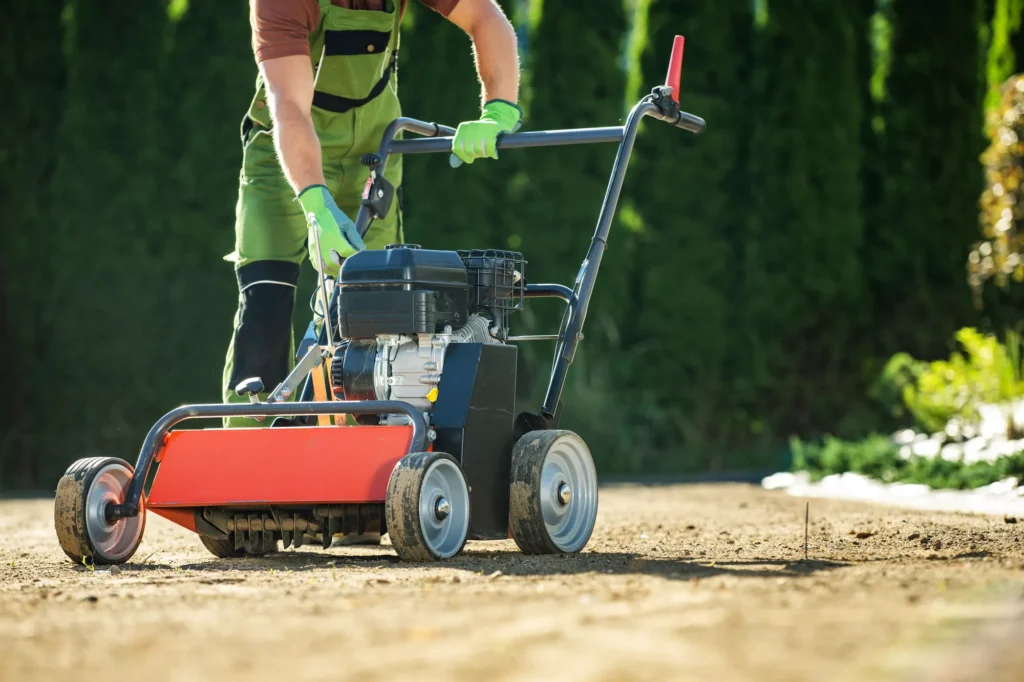
Core aeration is frequently paired with overseeding because the openings left by the aerator create favorable seed-to-soil contact.
Instead of grass seed resting primarily on top of existing vegetation, some seeds can settle into aeration holes and exposed soil areas. This can give new seedlings better access to moisture and improve their opportunity to establish.
The combination can be particularly useful for lawns that have:
- Thin grass coverage
- Bare or weak areas
- Soil compaction
- Damage from summer heat
- Heavy recreational use
- Gradual turf decline
Precision Lawn & Landscape provides both aeration and overseeding as part of its Northern Virginia lawn care services.
Core Aeration vs Dethatching: How to Choose the Right Treatment
If you are unsure whether your lawn needs aeration or dethatching, start by diagnosing the specific problem instead of choosing the treatment first.
Consider core aeration when:
- The ground feels hard and compacted
- Water frequently pools or runs off the lawn
- The property receives substantial foot traffic
- Turf roots appear shallow
- Grass has difficulty growing despite regular care
- You plan to overseed a thin lawn
Consider dethatching when:
- The lawn has a thatch layer thicker than roughly one-half inch
- The surface feels unusually spongy
- Water and lawn treatments struggle to reach the soil
- Roots appear concentrated within the organic layer rather than the soil
- A dense mat of stems and roots has accumulated below the grass blades
For some properties, the symptoms may overlap. A professional lawn assessment can help determine whether compaction, thatch, nutrient deficiencies, drainage problems, disease, or another factor is responsible for declining turf.
Professional Core Aeration Services From Precision Lawn & Landscape
At Precision Lawn & Landscape, we provide professional lawn care services throughout Northern Virginia, including core aeration services for residential properties. Our core aeration process uses professional aeration equipment to pull plugs from compacted soil, helping improve access to air, water, and nutrients within the grass root zone. Our broader lawn care services also include fertilization, weed control, overseeding, disease control, and insect control.
We serve homeowners throughout Northern Virginia, including communities such as Woodbridge, Manassas, Dumfries, and surrounding areas. As a locally owned company serving Northern Virginia, we understand the regional growing conditions and turf challenges homeowners encounter throughout the year.
For qualifying projects, we also offer financing options through HFS. Financing can provide customers with additional flexibility when planning eligible lawn, landscape, irrigation, or other property improvement projects, with available terms and eligibility depending on the selected financing option.
Contact Precision Lawn & Landscape for Core Aeration Services
The debate over core aeration vs dethatching ultimately comes down to diagnosing what is preventing your grass from performing at its best. Dethatching removes excessive organic buildup above the soil, while core aeration addresses compaction below the surface. Applying the right treatment to the right problem can help create healthier growing conditions, improve root development, and build a stronger lawn.
If compacted soil is limiting the health of your Northern Virginia lawn, Precision Lawn & Landscape is ready to help. Contact us today for a free quote on professional core aeration services and give your grass better access to the air, water, and nutrients it needs to thrive.
FAQs
Core aeration removes small plugs of soil to relieve compaction and improve the movement of air, water, and nutrients into the root zone. Dethatching removes excessive organic material that has accumulated between the grass and soil surface.
A lawn that feels hard, has pooling water, or receives heavy foot traffic may benefit from core aeration. A lawn that feels soft or spongy and has a thatch layer thicker than about one-half inch may be a better candidate for dethatching.
Many lawns benefit from core aeration once a year or every other year, depending on soil type, traffic, and the severity of compaction. Lawns with dense soil or frequent foot traffic may need aeration more regularly than lightly used lawns.
Dethatching should usually be performed only when excessive thatch has actually developed rather than automatically every year. Some lawns may go several years without needing dethatching at all.